
Most of my work focuses on the United States economy for obvious reasons: the majority of our clients have the predominance of their assets invested in U.S. dollar-based assets. Yet while the U.S. economy represents 26% of global GDP, Europe isn’t far behind at 22%, with China at 19%. These three economic blocks total a whopping 67% of total global GDP activity.1 So, monitoring economic prospects outside our own border is appropriate.
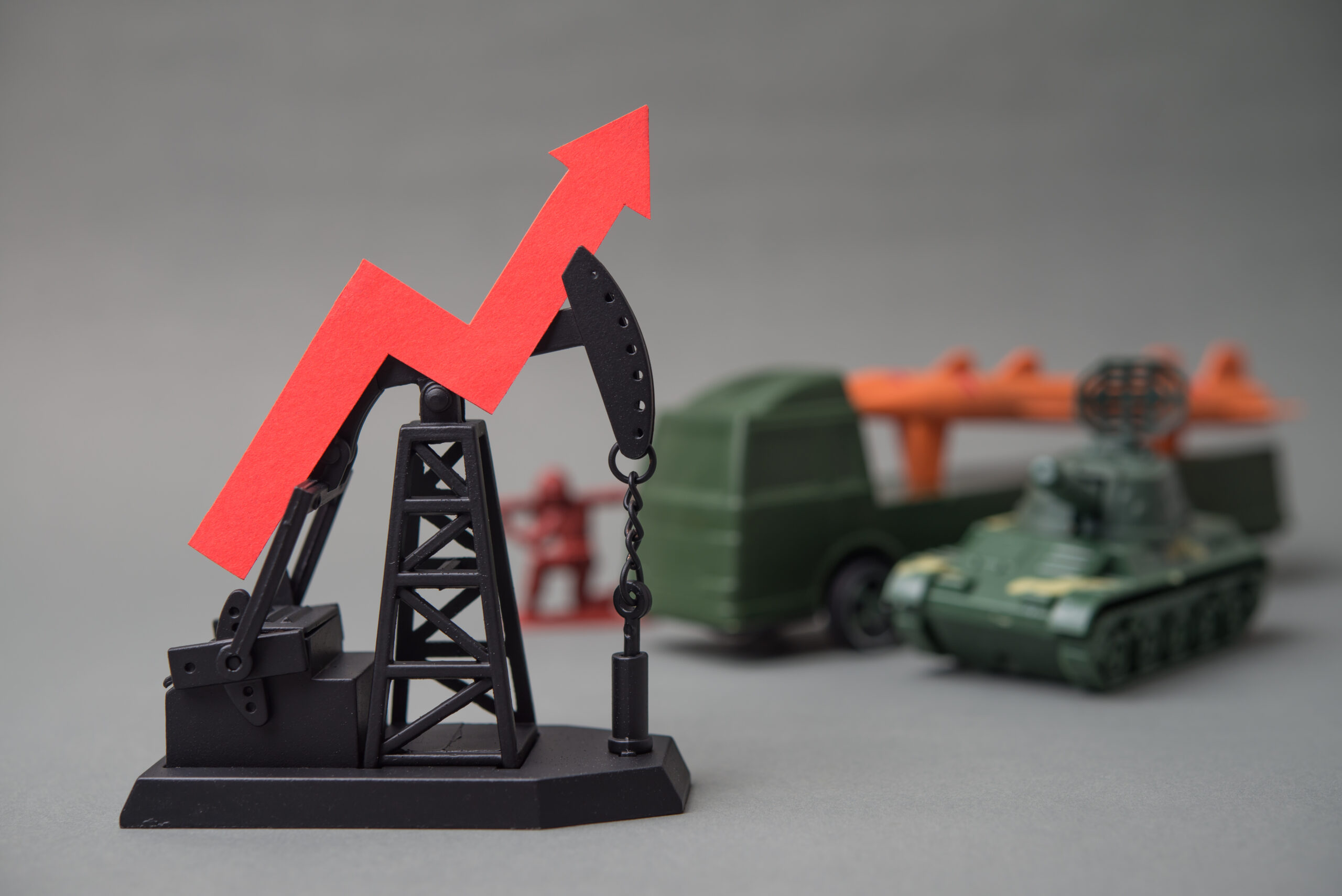
We turn to the Iran war. Oil prices have risen and with this event, the negative impact on growth and inflation pressure is starting to show up in many economists’ growth and inflation expectations. The impact is more intense, of course, on those areas of the world that don’t have carbon-based energy sources at their disposal but rely on these fuels to help drive their economies. We in the U.S. are blessed in the fact that we’re “energy independent.” While we remain net importers of crude oil, we’re net exporters of other fuel types.
But Europe and much of the rest of the world are on the opposite side of that stance. Europe, China and Japan are all oil (and carbon-based) energy importers. In Europe’s case, they import upwards of 97% of their oil need, with 3% being supplied by North Sea production.2 Additionally, oil trading outside of the U.S. is priced by BRENT pricing which tends to be higher than U.S.-based West Texas Intermediate.
Since the start of hostilities in Iran and the closure of the Strait of Hormuz, BRENT oil pricing has increased from $72 to $114 per barrel by April 30—an increase of $42 per bbl, or by 58%. Europe imports about 97% of their oil needs, or 3.39 billion barrels per year.
Due to the current higher pricing, the price increase represents a “tax” on the European economy, which has been forecasted to be a 0.6% drag on nominal GDP equating to a roughly $139 billion tax.3 This all assumes the oil price increase remains in place for a 12-month period of time.
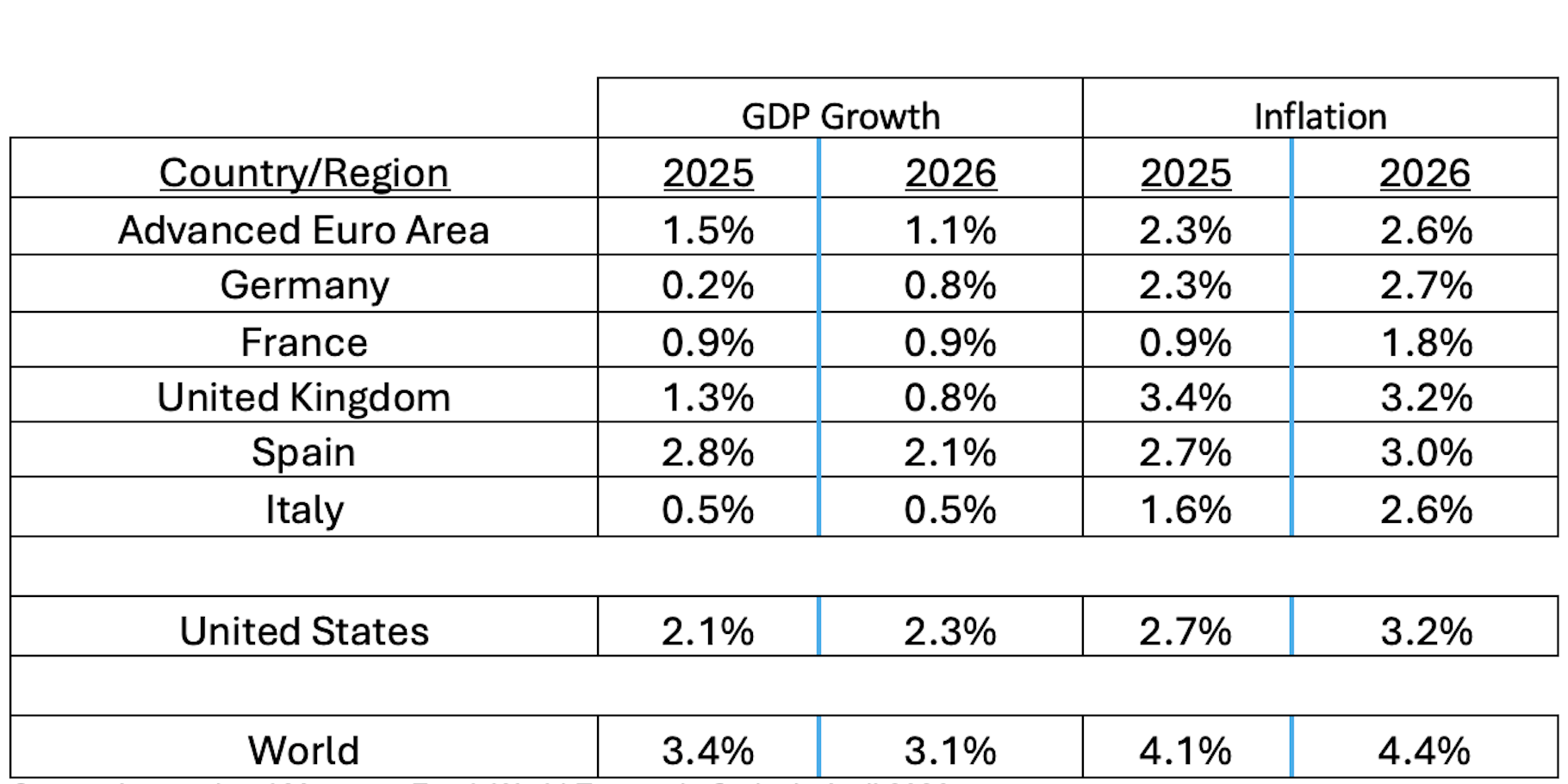
This kind of tax would be noticeable for most economies, but it would be worrisome for economies are growing slowly. Below are the new IMF’s expectations for European, U.S. and global growth/inflation in 2026.
Source: International Monetary Fund, World Economic Outlook, April 2026,
https://www.imf.org/en/publications/weo/issues/2026/04/14/world-economic-outlook-april-2026
A quick word on IMF’s work: the International Monetary Fund is a European-based economic think-tank (government sponsored) that, in my opinion, tends to be reactionary rather than anticipatory in much of their work. This isn’t unusual for economic research. As an example, our own Federal Reserve tends to be reactionary in their monetary policy adjustments rather than anticipatory.
That all said, other highly respected sources suggest the IMF’s data noted above may be too optimistic. The German government’s official growth expectation was just halved from 1.0% to 0.5% this year.4 The countries noted above are all large, developed countries with meaningful economic heft. As a group, they’re expected to grow by around 1% this year. If oil prices remain high, that growth may disappear and Europe may slide towards recession.
Ed Yardeni (of Yardeni Research) has noted that Europe still burns non-renewable energy sources to generate upwards of 80% of their energy needs. And this is following massive spending in Europe on renewables, wind and solar. The continued dependence on imported carbon-based energy sources leaves the continent at the tender mercies of others.
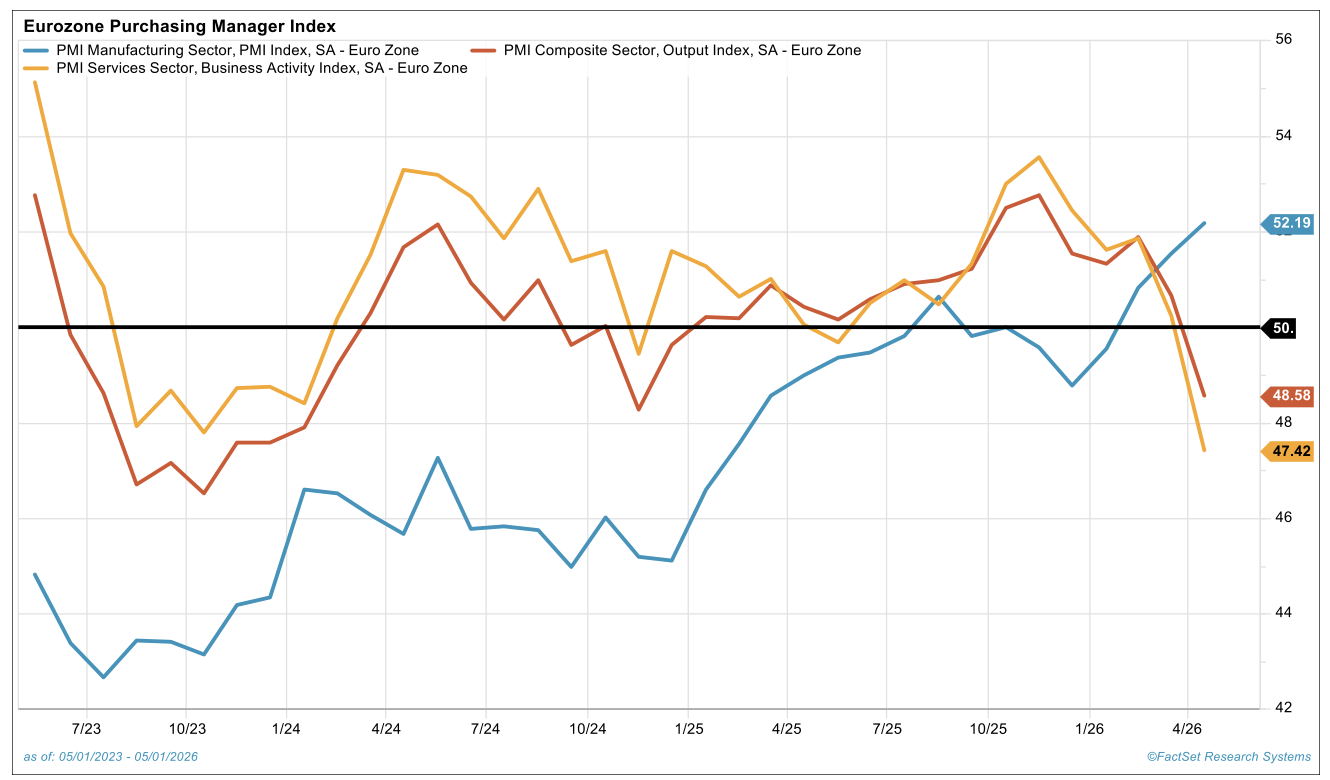
Recently Europe’s PMI index was released, showing broad weakness in the composite data, which has fallen from last year’s high readings to the current 48.6, suggesting business momentum is slowing (see chart below).
Source: FactSet
So, we’re seeing the specter of a stagflationary environment taking form in Europe if building inflation pressures don’t ease. We’ve been forecasting U.S. GDP growth this year of 2.5% to 3.0%, an acceleration from last year’s 2.1% growth and slightly stronger growth than expected by the IMF. The U.S. economy will probably share Europe’s profile of higher inflation pressures this year as compared to 2025, but Europe’s growth momentum may indeed slow, as compared to the U.S.
The european central bank
This profile may lead the European Central Bank (ECB) to raise interest rates this year, if oil prices remain firm and inflation pressures continue to build.
In 2022, when Russia invaded Ukraine and oil prices spiked, the ECB hesitated to fight the upward inflation pressure, a blemish on the ECB’s record. The ECB’s primary mandate is to maintain a stable pricing environment, as compared to the Federal Reserve’s dual mandate of pricing stability and full employment. So the ECB is mandated to be more highly focused upon fighting inflation than the Fed.
If the ECB starts to raise interest rates while economic growth is waning, the possibility of Europe falling into a recessionary environment might be enhanced.
On the other hand, if Iranian hostilities come to a quick end, I suspect oil prices may indeed retreat. Some believe even if this happens, oil prices may remain higher than pre-war levels as oil reserve levels have been depleted, suggesting that demand for oil to replenish reserve levels will be higher than normal, which of course supports a higher oil pricing regime.
Germany – case in point
Source: FactSet
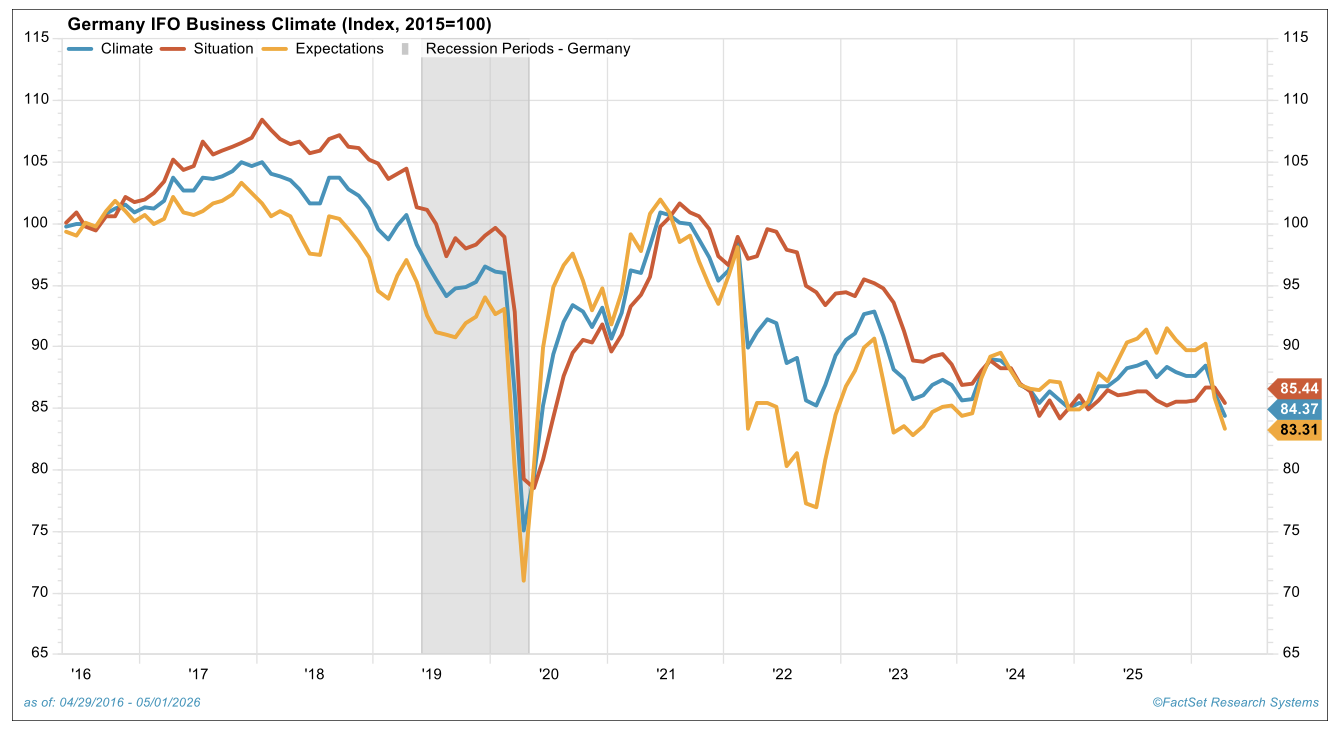
Recently, Ed Yardeni highlighted his view that Germany, being the largest economy in Europe, is of special importance when thinking of Europe’s economic prospects. The ifo Institute’s Business Climate Index registered its weakest reading in German business climate since the Covid pandemic (chart above).
We’ve been hopeful of a renewed growth effort to take place in Europe, the world’s second largest economic power, which would benefit all global businesses. But at the least, with the Iranian conflict still occurring and oil prices at higher levels, Europe’s core economies are at risk of experiencing a growth slowdown and perhaps an outright recession.
Politically motivated decisions may not work
As a sidebar, in 2011 the Fukushima Daiichi nuclear accident occurred, a catastrophic nuclear failure that was triggered by a 9.0 magnitude earthquake in Japan, which led to a 14-meter tsunami. Following this disaster, many in the world questioned the wisdom of utilizing nuclear fusion as a means of creating electricity.
At that time, many countries in Europe decided to shut down their nuclear reactors and switch power generation methods from nuclear to other forms, including natural gas, a fuel which officials then pronounced a clean, non-polluting fuel. Since the Fukushima problem, a total of 37 nuclear electricity generation stations have been closed in Europe and replaced primarily with natural gas generating stations, gas that has been supplied by Russia for much of this time.
Germany was a leader in this “anti-nuclear” movement, closing all 17 of their nuclear plants and becoming attached to natural gas generation systems, fueled largely by Russian gas imports. France decided not to close their nuclear plants.
Recently many around the world have been focusing on nuclear-powered electric generation as a viable solution to the growing need for additional electricity generation, which has been spurred by the buildout of large data centers, AI and EV adoption. According to the World Economic Forum, 40 new nuclear electricity plants are currently under construction, in a global movement towards nuclear electricity generation.
In 2011, I found it curious that so many in Europe decided to move away from nuclear electricity generation by closing plants that had been operating safely for quite some time. After all, most of Europe is neither subjected to massive earthquakes nor large ocean-driven tsunamis as is the case in Japan. Europe is now being held hostage to carbon-based energy pricing and availability more than was the case 15 years ago.
Politicians are famous for making decisions which may be politically expedient, but longer-term unwise. Take care of what you want; you may indeed get it.
- Source: World Bank Group. https://data.worldbank.org/indicator/NY.GDP.MKTP.CD?most_recent_value_desc=true
- Source: European Council: https://www.consilium.europa.eu/en/infographics/where-does-the-eu-get-its-oil-from/
- Source: Oxford Economics: https://onlinelibrary.wiley.com/doi/10.1111/1468-0319.70046
- Source: Reuters: https://www.reuters.com/business/german-economy-ministry-halves-2026-growth-forecast-raises-inflation-outlook-2026-04-22/
This commentary is provided for informational and educational purposes only. As such, the information contained herein is not intended and should not be construed as individualized advice or recommendation of any kind.
The opinions and forward-looking statements expressed herein are not guarantees of any future performance and actual results or developments may differ materially from those projected. The information provided herein is believed to be reliable, but we do not guarantee accuracy, timeliness, or completeness. It is provided “as is” without any express or implied warranties.
There is no assurance that any investment, plan, or strategy will be successful. Investing involves risk, including the possible loss of principal. Past performance does not guarantee future results, and nothing herein should be interpreted as an indication of future performance. Please consult your financial professional before making any investment or financial decisions.