
Economic growth and inflation pressure in question
This commentary was prepared during a period of rapidly evolving geopolitical developments surrounding Iran and heightened volatility across energy markets. While events may continue to unfold, the analysis that follows is intended to frame the potential economic implications for growth and inflation based on the information available at the time of writing.
Recent remarks from JPMorgan CEO Jamie Dimon, as reported by CNBC, point to a potential shift in regional dynamics. Dimon highlighted a growing alignment of interests among key players, including Saudi Arabia, the United Arab Emirates, Qatar, the U.S. and Israel, toward achieving a more durable peace in the region. As he noted, the attitude today is not what it was 20 years ago, and there appears to be broader interest in reaching a lasting resolution.
Should tensions ease, the economic pressures discussed here may prove temporary. If not, the framework outlined below may help in assessing how sustained geopolitical conflict, particularly through energy markets, can influence the path of global growth and inflation.
Coming into the year, most economic forecasters were looking for some degree of economic growth acceleration to occur in 2026. The U.S. economy grew by 2.1% in 20251 (latest read) and as shown below, the Fed was looking for 2.3% growth in 2026 tied with a projected 2.4% inflation rate. Then the missiles started flying in Iran and oil prices spiked to over $100 per bbl.
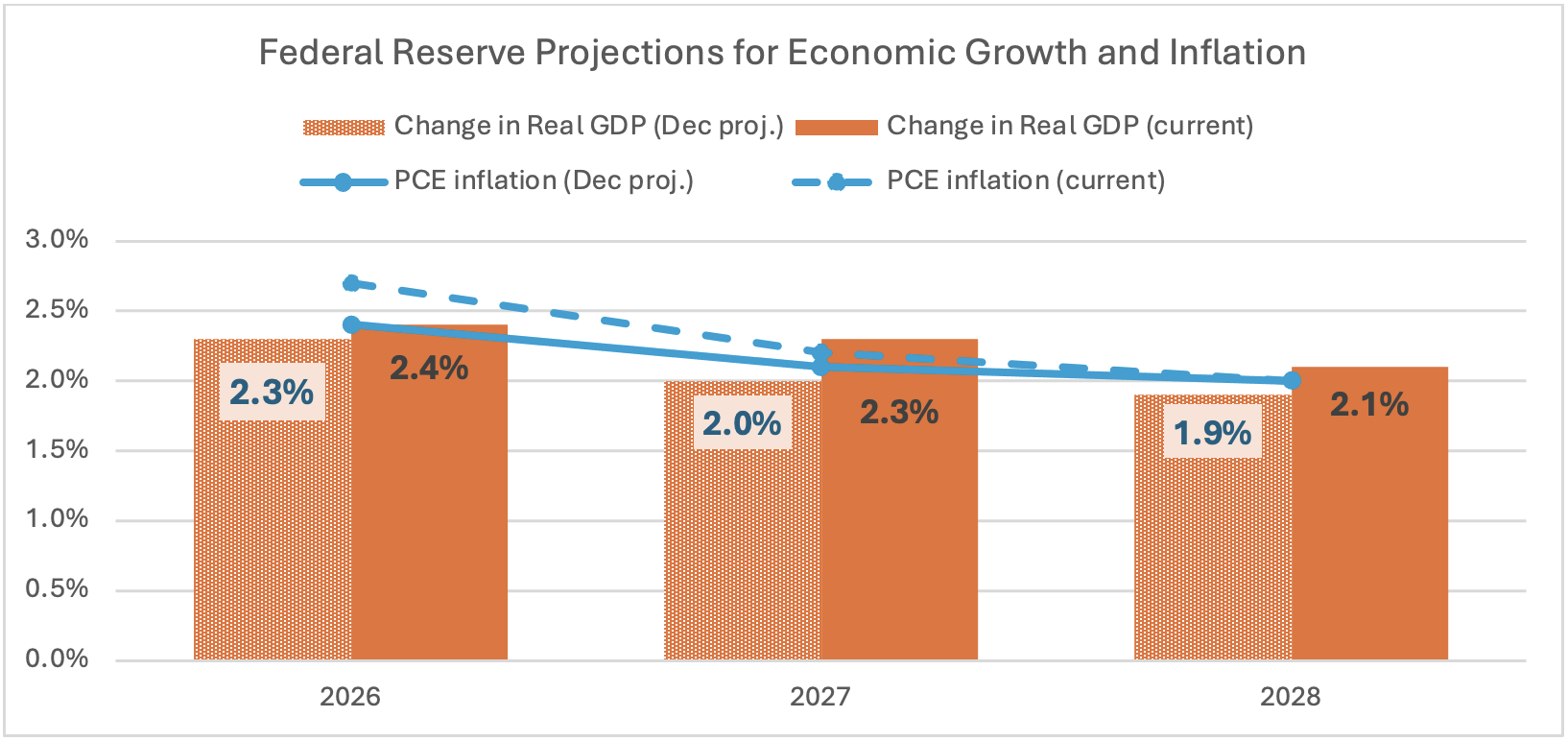
Source: Data sourced from the Federal Reserve’s Summary of Economic Projections released on March 18, 2026.
The war in Iran has now been ongoing for five weeks. It is too early to expect to see any hard data suggesting concrete levels and types of impact. But we do know that capital markets wait for no one. Brent crude prices (which most of the world outside the U.S. uses while the U.S. uses West Texas Intermediate) surged to ~$119 per bbl. from $73, a roughly 63% rise since the start of hostilities on Feb. 28. Prices have come back down slightly and were trading just north of $107 per bbl. at the time of this writing on March 26.2
We in the U.S. are fortunate compared to most developed countries in that we are net exporters of petroleum products. Most countries—Europe, Japan and China—are all petroleum importers. The oil price increase acts as a tax directly on all consumers and pushes inflation pressures to the upside on a global scale.
That said, gasoline prices in the U.S. are still showing upside pressure (chart below), rising from $2.89 per gal. on Feb. 27 to $3.66 on March 20, a price-spike of 26% over that three-week period, indicating that at least temporarily, an upside push in U.S. inflation (headline) is occurring. How sustainable will this upward push be? We’ll see how the war unfolds.
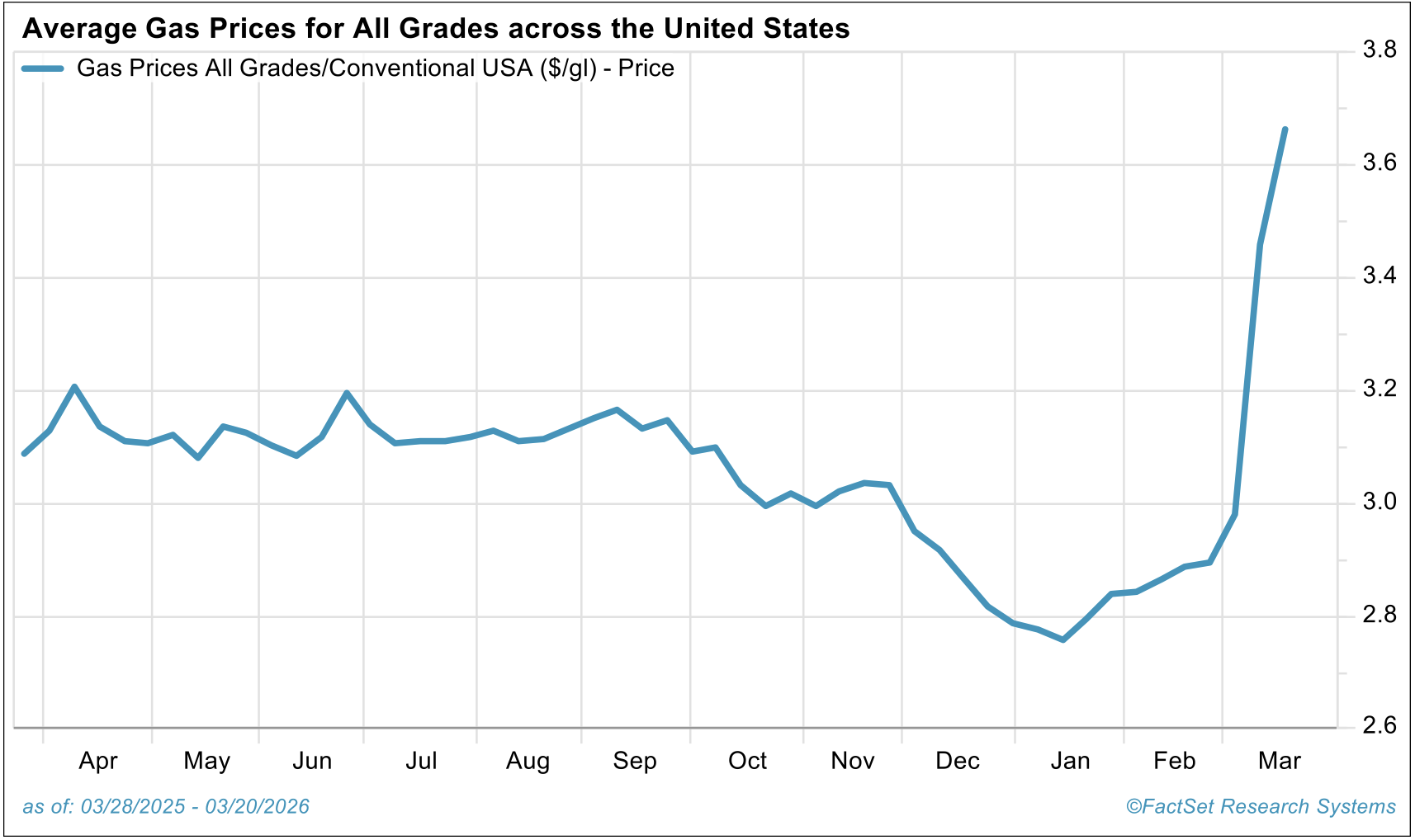
Source: FactSet
Central banks don’t create oil molecules
Rising oil prices tend to shove inflation upwards and bring growth down. What can the Fed do about the oil price issue? If we have an inflation problem, the Fed tends to tighten money supply growth by raising interest rates. If we have a growth problem, they simply expand the size of their balance sheet and lower rates. What if we have both risks occurring at the same time, which normally comes with a SUSTAINED oil price spike?
A spike in oil prices isn’t just a final demand issue. It’s a supply problem that can be solved by an end to hostilities and a resumption in oil flowing unhindered through normal supply channels. The Fed can’t solve the oil price problem. The Fed can’t create oil molecules. The Fed’s ability to handle this issue is limited.
Some capital markets aren’t waiting to see what central bankers will do. Note the chart below: the 2-year U.K. Gilt yield increased by more than 100 bps quickly after the start of hostilities. This shows that the U.K. bond market is expecting the Bank of England to start raising interest rates to fight growing inflation issues.
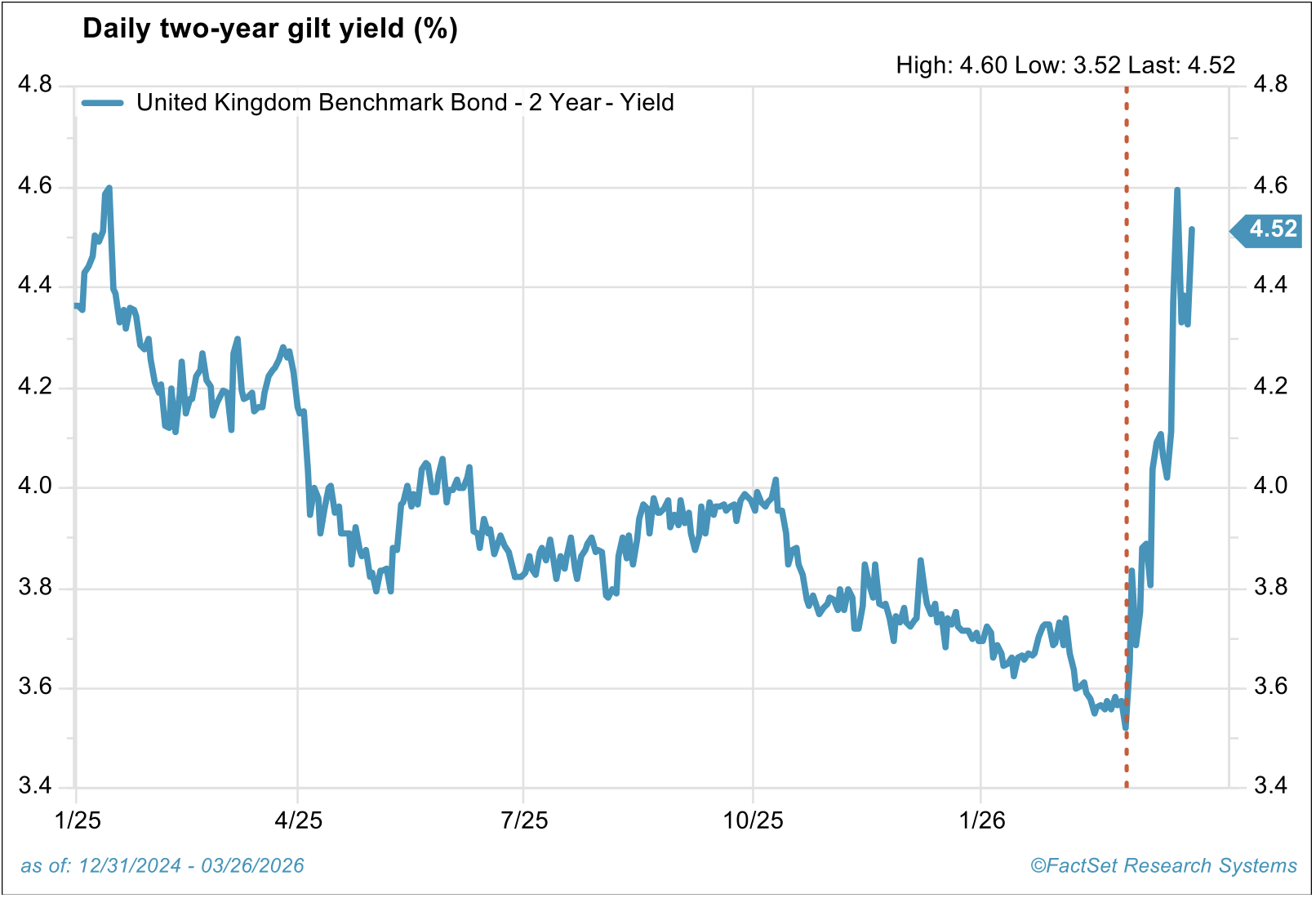
Source: FactSet
Inflation fighters first
Faced with the dilemma of slow economic growth or rising inflation, most central banks will focus on fighting inflation first. Yet doing so through tightening money supply tends to soften final demand growth rates (and GDP growth rates). Governmental fiscal activity can address issues regarding final demand and growth. Governmental fiscal policies tend to be ineffective in fighting inflation. Fighting inflation tends to be a central bank game.
It seems at this stage the real loser in the current environment will be Europe and Japan, as they import most of their carbon energy needs, while we in the U.S. are fortunate to be a petroleum exporter. But gasoline prices have still increased since the start of hostilities here at home.
So, hostilities need to end, which should bring oil prices and inflation downward. We hear reports that perhaps an end to hostilities is at hand; we hope that to be the case. If not, we should expect to see central bankers around the world start to address the issue.
Latest data in U.S.
Gasoline prices in the U.S. have risen by 35% for the four weeks ending on March 23.3 How has this move impacted consumer sentiment, which is a good measure of consumer’s willingness to consume?
The University of Michigan’s latest consumer sentiment survey shows consumer’s attitudes have deteriorated meaningfully, with overall sentiment falling 5.8% and consumer expectations dropping 8.7% month over month.4 Meanwhile, another high frequency data point—initial unemployment claims—suggests the jobs market yet to show a significant downturn, as weekly initial unemployment claims have continued to decline.
So, we’ve yet to see concrete data suggesting that the U.S. economy is deteriorating. But it is early.
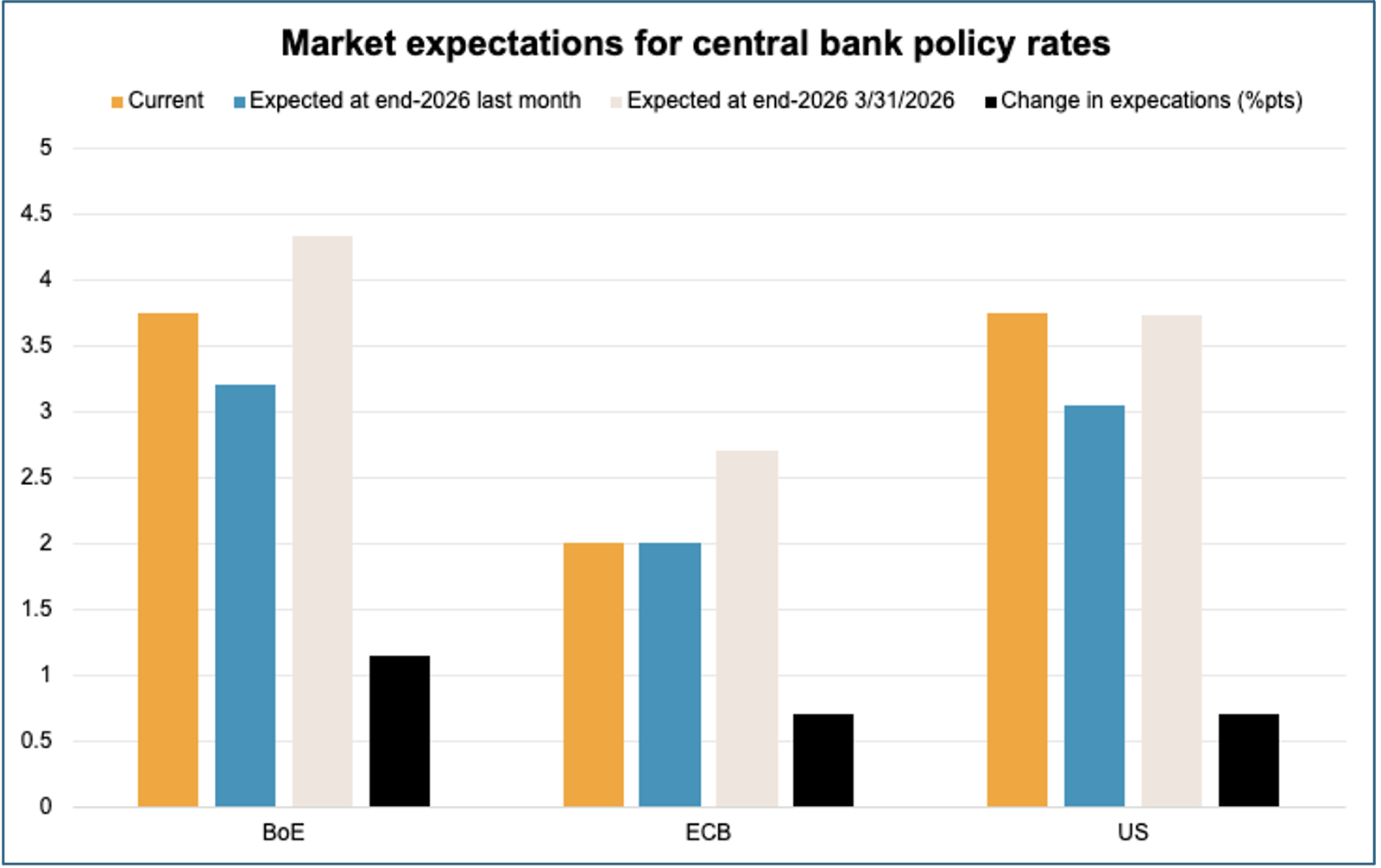
As noted earlier, market participants are coming to the belief that central bankers won’t be lowering rates, as the upward push on inflation rates may indeed be higher than expected due to increased oil prices. This changed expectation is highlighted on the chart below, which compares current expectations of central bank policy shift as compared to the recent past for three major central banks.
Note that the survey results show that both the European Central Bank (ECB) and the Bank of England (BOE) are now expected to increase rates by the end of the year rather than reduce them. The survey also shows that the majority of those polled now think the Fed’s rate cuts may indeed not occur.
Source: FactSet
Along those lines, the latest poll from the Federal Open Market Committee (FOMC) suggests the policymakers’ preferred inflation measure, Core Personal Consumption Expenditures (Core PCE) has moved higher. In December of last year, the intra-Fed poll showed that the FOMC’s expectation for inflation this year was 2.5%.5 At that time, I framed my inflation outlook to be closer to 3% this year. With the latest events, the Fed is moving towards my expectation.
How thick is your cushion?
Some are asking if the $35 per bbl. oil price increase will throw major economies into recession; they ask what kind of impact a $35+ per bbl. increase in oil prices may bring to the U.S. economy. The folks at Oxford Economics suggest that every $10 sustained change in oil prices affects U.S. GDP growth by .15%. Per the same folks, inflation is impacted by the same move in oil prices by 0.25%. Again, these ratios apply to sustained oil price changes, and not just temporary movements.
If we assume oil prices settle where they are currently trading ($93 per bbl. WTI) those ratios suggest a cost of 0.5% in U.S. GDP growth and an uptick of 0.9% in inflation pressure. Given the data we have seen for the year ending Dec. 31, 2025, this suggests GDP growth will shrink from 2.1% to 1.6% and inflation will rise from 2.4% to 3.3%.
The impact is heavier in countries who import most or all of their carbon energy fuels. This includes most of Europe and Japan. Will the economies of these countries risk falling into recession, given a major sustainable increase in the price of oil? Much of the answer to that question resides in the growth profile these countries bring into the oil price spike, the growth cushion to shocks, if you will.
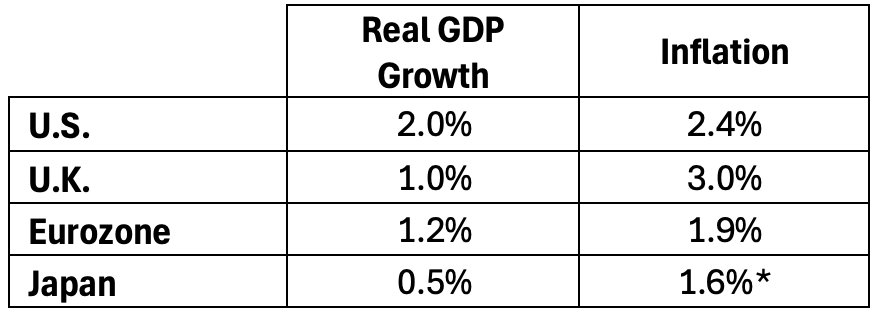
Data Sourced from FactSet and is trailing twelve months as of 12/31/25. Inflation is 12-month change in Consumer Price Index *Japan excludes fresh food.
The impact cushions noted above for the U.S. probably understates the impact other parts of the world will experience due to a sustained increase in the price of oil. But seeing the impact on the U.S. may be -0.5% in growth and +0.9% in inflation, one can assume that both Europe and Japan may indeed risk falling into recession if oil prices stay at today’s level for a sustained period of time.
Time and events in Iran will tell.
Sources:
- Source: Bureau of Economic Analysis
- Source: FactSet
- Source: International Energy Agency
- Source: University of Michigan Surveys of Consumers
- Source: Federal Reserve’s Summary of Economic Projections
This commentary is provided for informational and educational purposes only. As such, the information contained herein is not intended and should not be construed as individualized advice or recommendation of any kind.
The opinions and forward-looking statements expressed herein are not guarantees of any future performance and actual results or developments may differ materially from those projected. The information provided herein is believed to be reliable, but we do not guarantee accuracy, timeliness, or completeness. It is provided “as is” without any express or implied warranties.
There is no assurance that any investment, plan, or strategy will be successful. Investing involves risk, including the possible loss of principal. Past performance does not guarantee future results, and nothing herein should be interpreted as an indication of future performance. Please consult your financial professional before making any investment or financial decisions.